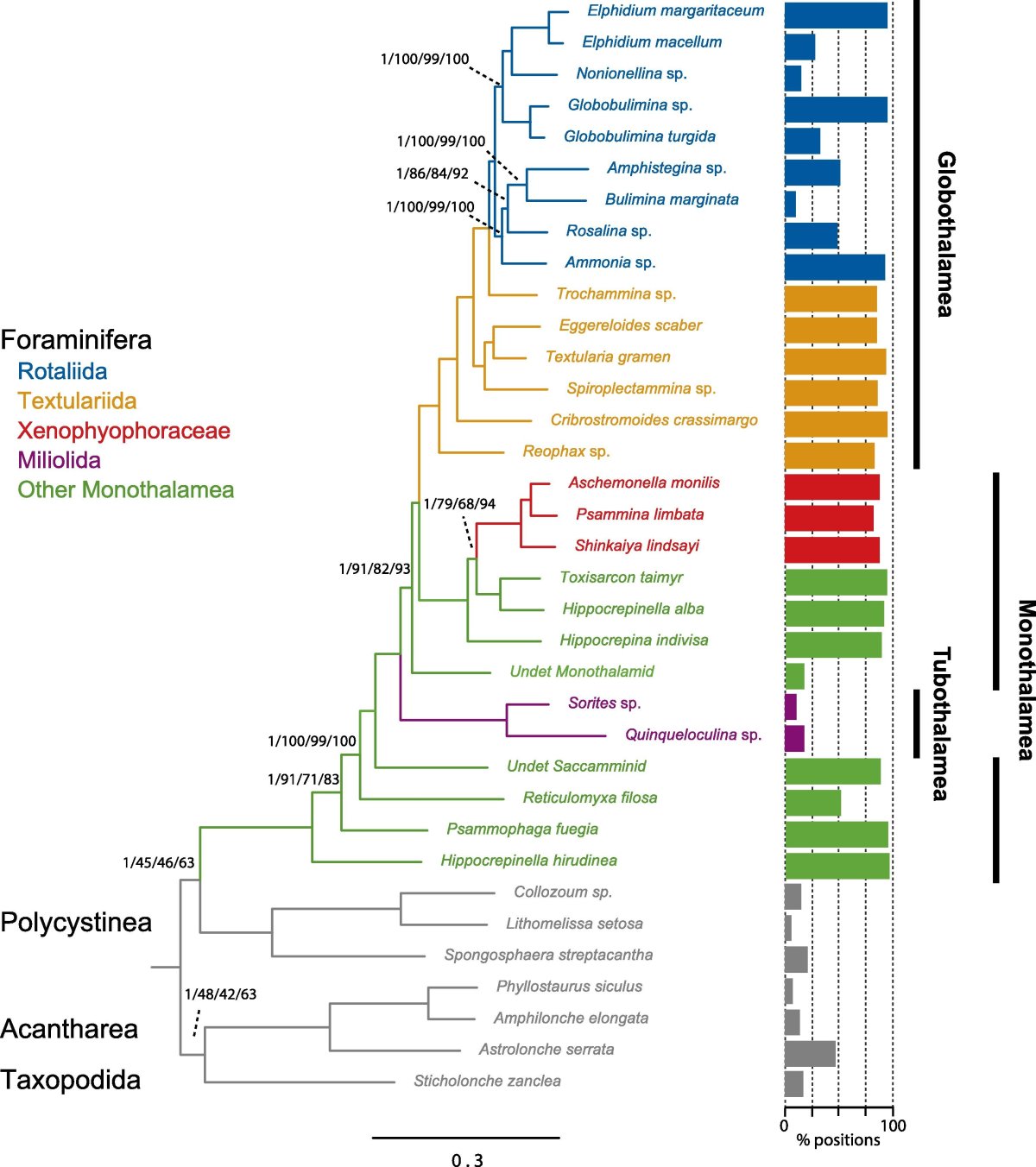
We investigated the evolutionary relationships of Foraminifera, a diverse group of marine protists critical for marine ecosystems and paleoclimate studies. Traditionally, their molecular phylogeny relied on ribosomal RNA data, which has limitations. To address this, we used transcriptomic data from 28 species, including 19 newly sequenced taxa, focusing on underrepresented groups like Monothalamea. By analyzing 199 protein-coding genes, we constructed phylogenomic trees to clarify their evolutionary history.
Key Findings:
- Confirmed Foraminifera’s monophyly and their close relationship with Polycystinea.
- Found Monothalamea (single-chambered) to be paraphyletic, giving rise to more complex Tubothalamea and Globothalamea.
- Revealed Xenophyophorea (large, deep-sea Foraminifera) as a highly derived lineage within Monothalamea, not primitive as previously thought.
- Clarified relationships within Globothalamea, supporting the paraphyletic nature of Textulariida and the monophyly of Rotaliida.
This study provides the first comprehensive phylogenomic reconstruction of Foraminifera, resolving longstanding questions and highlighting evolutionary transitions, such as the development of multi-chambered structures. It also demonstrates the value of transcriptomics in addressing complex phylogenetic questions.
For more information, see the published paper.